What to Sell Online in November 2026: A Practical Guide to Products, Profit and Platforms
Choosing what to sell online in November 2026 starts with a practical question: can you deliver something useful at a price that leaves money after every cost? For a small Bangladesh-based business, our recommended first test is a narrow ra

Choosing what to sell online in November 2026 starts with a practical question: can you deliver something useful at a price that leaves money after every cost? For a small Bangladesh-based business, our recommended first test is a narrow range of locally sourced home textiles or compact organizers. For international selling, validate one destination and its delivery economics before buying stock.
Reviewed 19 November 2026. Published by DokanEasy. Recommendations below are our editorial assessment, not a verified ranking of bestselling products or a profit guarantee. Market reports describe their stated dates and locations. Platform details come from public documentation; we have not benchmarked either provider’s sales performance.
What the current market evidence actually says
Adobe’s September 28 holiday forecast projects US online spending of $275.1 billion for November–December 2026, up 6.7% year on year. It forecasts electronics at $63.3 billion and apparel at $51.3 billion. These are US forecasts, not completed sales or a worldwide product ranking. A large category does not establish that a small seller can compete profitably inside it.
Bangladesh requires a different reading. BSS’s November 9 report citing BBS puts October general inflation at 8.27%, food inflation at 6.40% and non-food inflation at 9.89%. Slower annual inflation does not mean the overall price level fell. Meanwhile, The Daily Star’s November 14 market report describes rising prices for several vegetables in sampled Dhaka markets, while some poultry prices fell. These observations are dated snapshots, not November 19 supplier quotes.
Three product ideas worth testing, and their trade-offs
1. Useful home textiles. Consider a small towel set, washable kitchen cloths or simple cushion covers. Our reasoning: samples are straightforward to inspect, use is easy to demonstrate, and local sourcing can shorten replenishment. Check stitching, shrinkage, colour transfer and actual measurements. Avoid an oversized range of colours before learning what customers reorder. This is a testable business idea, not evidence that textiles are today’s top-selling SKU.
2. Compact organizers and practical bundles. A desk pouch, travel storage set or small fabric organizer can solve a visible problem. Photograph the real dimensions beside familiar objects. Bundle genuinely complementary items instead of inflating the advertised value. Reject brittle components, bulky packaging and products whose shipping cost overwhelms the selling price.
3. Traceable personal-care essentials. Consider this only with authentic supply, invoices, batch identification and suitable storage. Recurring use is a reason to investigate, not proof of repeat purchases. Check applicable product requirements before listing. Do not build a launch around unverifiable health claims or mystery imported stock.
Fresh groceries deserve a separate model: a limited delivery zone, scheduled routes, clear weights, daily buying prices and a spoilage allowance. Their necessity does not automatically produce a healthy margin. Powered gadgets also need more than attractive demand figures: warranty, compatibility, defect handling and replacement stock can absorb the apparent markup.
Price for delivered orders, not advertising dashboards
Calculate revenue after discounts, then subtract landed product cost, packaging, payment or COD charges, your delivery subsidy, advertising and an allowance for failed deliveries and returns. Include all relevant costs and taxes in your actual accounts. Remaining contribution must still cover subscriptions, wages, rent and other overhead before it becomes net profit.
Illustration only, not a supplier quote: a ৳1,000 collected sale minus ৳500 product cost, ৳30 packaging, ৳60 delivery subsidy, ৳20 collection cost, ৳150 advertising and ৳50 return allowance leaves ৳190 contribution. If advertising rises to ৳250, it falls to ৳90. Replace every input with your own delivered-order records; an attractive markup alone is insufficient.
Shopify or DokanEasy: compare the workflow and full bill
DokanEasy’s published offer: its plan page lists Free at ৳0 with 50 products and 100 monthly orders; Starter at ৳999/month with 450 products and 800 monthly orders, custom domains and Pathao/Steadfast courier integration. It advertises bKash/Nagad/COD workflows and 0% platform transaction fees. Payment, courier, domain and other service costs still need separate checking.
Shopify’s published offer: the USD pricing page lists Basic at $39/month, or $29/month billed yearly, and includes unlimited products. Country, billing and additional services affect cost. Its app ecosystem and international-selling tools merit evaluation when a specific integration or destination requires them; include paid apps and operational setup in the budget.
Payment eligibility matters: Bangladesh is absent from Shopify Payments’ supported-country list. A Bangladesh-based merchant should verify an eligible third-party provider or suitable manual method. Shopify’s manual-payment guidance explicitly excludes manual payments, including COD, from third-party transaction fees. Do not apply Shopify’s headline third-party fee to every COD order.
Our recommendation: start by testing DokanEasy for a Bangladesh-first shop whose payment, courier and catalogue requirements fit its plans. Shortlist Shopify when you can identify a valuable app or international workflow and verify payment eligibility and total cost. Neither choice guarantees customers. Before committing, run an order, cancellation, refund, courier reconciliation and data-export check in the proposed setup.
A two-week launch plan with a clear decision point
Days 1–3: choose one customer problem, interview potential buyers and obtain dated quotes from more than one supplier. Buy samples rather than a large inventory. Days 4–6: select three to five products, inspect them, take accurate photographs and publish dimensions, materials, delivery charges and return terms.
Days 7–10: place test orders through the actual checkout and fulfilment process. Confirm addresses and COD arrangements, then run a capped advertising experiment you can afford to lose. For overseas orders, verify destination requirements, landed delivery cost and realistic arrival dates before accepting payment; do not promise holiday arrival without a dependable service.
Days 11–14: reconcile collected cash, courier statements, advertising and returns. Measure contribution per delivered order and record complaints by product. Reorder only when quality, fulfilment and contribution support it. If the test fails, adjust the product, audience or price before expanding the catalogue. A useful product and dependable delivery are a stronger starting point than a fashionable platform alone.
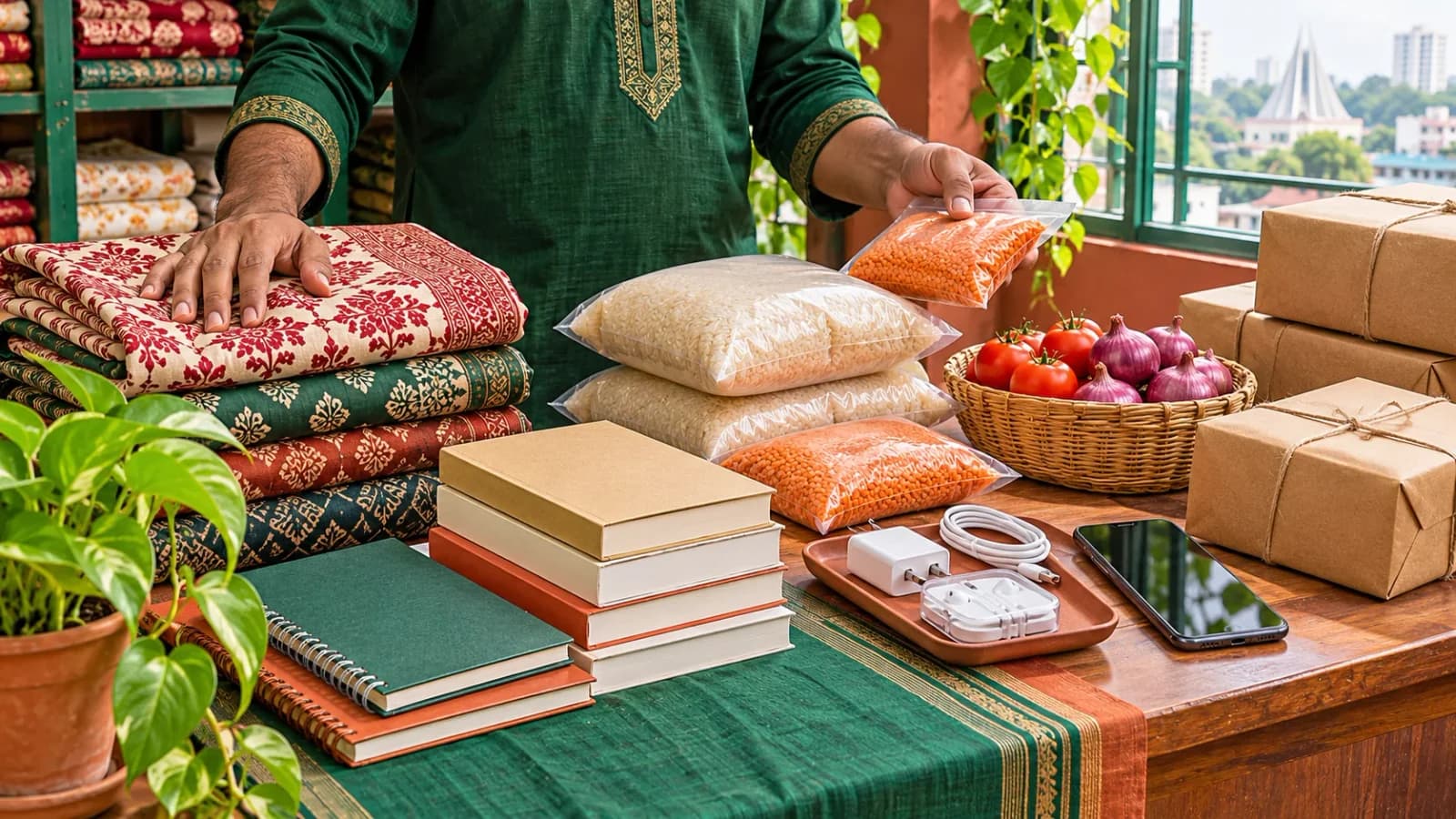
Ready to compare the Bangladesh workflow? Review the current plans on DokanEasy and start with the smallest suitable test. Read our companion Bengali guide for local sourcing, market-price examples and a Bangladesh-focused launch checklist. Cover artwork is AI-generated editorial illustration; it does not depict actual inventory or measured market data.